
Author:
Kai Knudsen
Updated:
26 August, 2025
In this chapter there are suggestions for recommended wake-up times after surgery in a postoperative ward as well as criteria for discharge. NEWS and a key for diagnosis registration are included.
- Postoperative Care and Treatment
- Recommended Observation Times in the Postoperative Department
- Postoperative Monitoring After Spinal Anesthesia
- Assessment of Patient Ready for Discharge
- Patient Discharge
- What is Needed for the Patient to be Discharged from ICU?
- NEWS
- Diagnosis List for Registration According to SIR within Intensive Care in Sweden
- Guide for Diagnosis Registration According to SIR
Postoperative Care and Treatment
Postoperative care includes recovery from anesthesia during supervised awakening with good pain management, proper nursing, and monitoring of vital signs. The airway is controlled and secured, oxygen is given liberally.
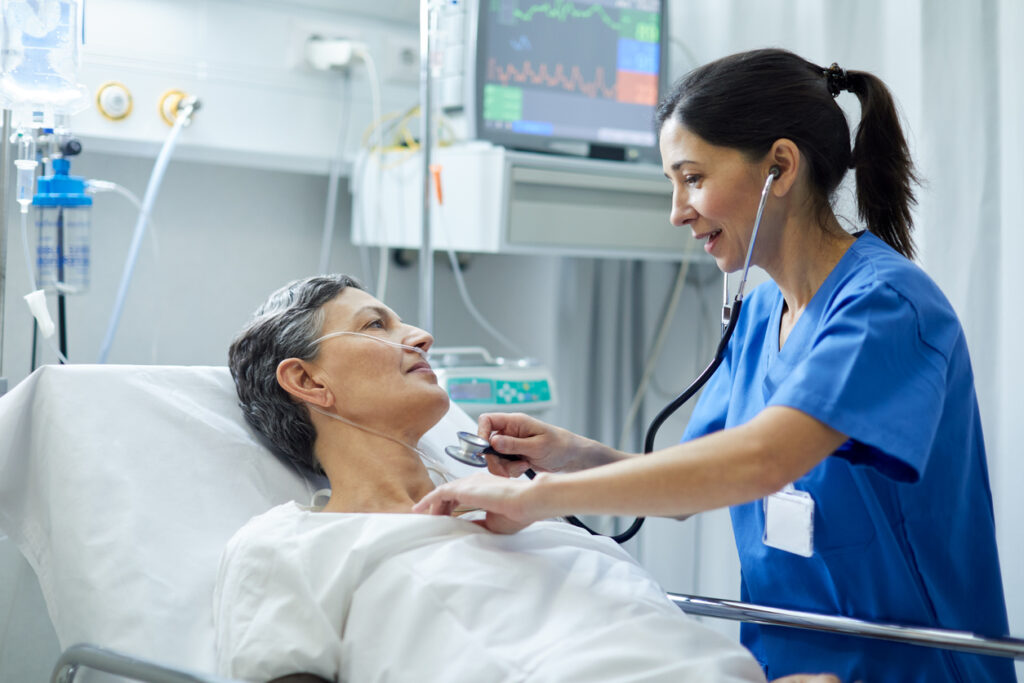
Initially, a standardized report is obtained from the anesthesia staff, either doctor or nurse. Monitoring equipment is then connected and initialized. If the patient is still intubated, a ventilator is connected with the corresponding ventilator settings. Each continuous infusion is set to an adequate dose of sedative and inotropic drugs, eg propofol, remifentanil or norepinephrine. Colloid and crystalloid infusions are given as prescribed. Control and registration of intraoperatively given units with blood products such as blood, plasma, platelets and albumin is done. Perioperative diuresis is recorded and a preliminary fluid balance is determined. It is decided whether continued hourly diuresis should be checked and a continued fluid plan initiated.
An initial arterial blood gas is taken if the patient has an arterial line inserted. In the initial phase of recovery, the airway is secured and the patient is properly positioned and supervised. Any mucus or secretions are removed by suction. All drainage is controlled and marked with correct levels. Active suction of wound drains is initiated. If necessary, additional sedation or pain relief is given. Epidural analgesia or other regional anesthesia is checked and recorded. After that, all vital parameters are checked and recorded regularly. The patient is turned regularly. The patient is allowed to recover from the anesthesia slowly and painlessly under continuous supervision. As soon as the patient is able to communicate, comfort and reassuring information is given. The result of the operation can be given later when the patient has fully recovered. All post-operative prescriptions are checked and recorded. Prophylactic antithrombotic drugs are given at the right time. Low-dose fractionated heparin is normally given 6 hours after major surgery. Prophylactic antibiotics are given as prescribed. Antiemetics are given if needed. If not yet extubated a plan for extubation is done. A plan for the time in the postop unit can be made according to the recommendations below.
Recommended Observation Times in the Postoperative Department
| Neurosurgical procedures | Recommended time for postoperative monitoring |
|---|---|
| Baclofen pump with start-up | Overnight (Control of arm strength and RLS) |
| Rear skull pit surgery | Overnight |
| Chiari | Overnight |
| Embolization of aneurysm | Overnight |
| Embolization AVM + vascular malformation | Overnight. Note bed position 1st day. |
| Epilepsy surgery | Overnight |
| Extirpation of AVM transcranially | Overnight |
| Fenestration of intracranial cyst | Overnight |
| Tethered cord | Overnight |
| Pituitary gland | Overnight |
| Cranioplastic surgery | Overnight |
| Shunt Vp/Va children | Overnight |
| Shunt Vp/Va removal | Overnight |
| Skull angiography with intervention | Overnight |
| Sterotactic brain electrode in Parkinson's disease | Overnight |
| SAH Subarachnoid hemorrhage | Overnight |
| TC | Overnight |
| TMS | Overnight |
| Vagus nerve stimulator placement | Overnight |
| Balloon compression | 7 h |
| Chronic subdural hematoma | > 7 h and 1 h after drains have been removed |
| Hydrocephalus ventriculostomy | >6 h + CT |
| Shunt Vp / Va post | >6 h + CT |
| Shunt Vp/Va revision | See memo |
| Baclofen pump insertion without start | 4 h |
| Battery replacement in stimulation system | 4 h |
| SCS-system Battery replacement | 4 h |
| SCS-system Battery removal | 4 h |
| Vagus nerve stimulator battery replacement | 4 h |
| Floating 2 | 2 h |
| Skull angio without intervention | 2 h note check angiography puncture site |
| Spinal angiography | 2 h obs check angiography puncture site |
| Rear cervical decompression | 6 h |
| Anterior cervical disc herniation one level | 3-4 h |
| Anterior cervical disc herniation several levels | Extended wake-up time |
| Cervical decompression front one level | 2 h |
| Cervical decompression front multiple levels | 6 h |
| Lumbar disc herniation | Simple wake up |
| Rear spinal fusion with fusion/fixation electively | 6-8 h |
| Intrathecal pain treatment | Overnight |
| Lumbar decompression | 2 h |
| Mutar prosthesis hip | 12 h |
| Osteotomy - Back | Overnight |
| Hemipelvectomi | Overnight |
| Sacrum amputation | Overnight |
| Neuroscoliosis | 2 days |
| Scolios | 6 hours |
| Thyroid surgery | 2 h |
| Gastroplasty | 4 h |
| Adrenalectomy-pheochromocytoma laparotomy / open | 4-6/6-10 h |
| Thoracic abdominal surgery (esophageal resection) | 2 days |
| Whipple operation | 1 days |
| Ileus | Simple wake up (2-3 hours) in good health |
| Nephrectomi donator | Simple wake up (2-3 hours) |
| Kidney transplantation | Simple wake up (2-3 hours) |
| Diep (double) | Overnight |
| Lefort I | 3 h |
| Lefort I complicated | 6 h |
| Sagital split | 3-6 h |
| Plastic surgery with vascularized transplant | Varying (Overnight) |
| Tonsil | 2 h |
| Radical neck | Overnight |
| Chemo embolization | 2-4 h |
| Hyperterm extremity cytostatics perfusion | 6-8 h |
| EVAR uncomplicated | 4-6 h |
| Carcinoid | Often Night |
| Liver artery embolization | 10-12 h |
| Liver artery embolization chemo | 2 h |
| Hepatic portal vein embolization | 2 h |
| Renal artery embolization | 10 h |
| RF-Ablation liver-kidney | 2 h |
| TIPS simple | simple wake up (2-3 h) |
| PTC | simple wake up (2-3 h) |
| Femoral by pass | 6-8 h |
| TEA carotis artery | 6 h |
| Ralph (Robot assisted prostatic ) | 2 h |
| Nephrectomy open | 6-12 h |
| Nephrectomy laparoscopic | 6 h |
| Kidney resection | 6-12 h |
| Adenoma enucleation | 6-12 h |
| Bricker bladder deviation | Overnight |
| Cystectomy and ileocystoplasty | 6-12 h |
| Kocks reservoir/nipple audit | Overnight |
| Nephroureterectomy | 6-12 h |
| Transvesical adenoma enucleation | 12 h |
| Kidney pelvic plastic surgery | 6-12 h |
Neurosurgical Interventions – Recommended Time on Postop
- Baclofen pump with start-up – Night (Check arm strength and GCS)
- Posterior cranial fossa procedure – Night
- Chiari – Night
- Embolization of aneurysm – Night
- Embolization AVM + vascular malformation – Night (Bed rest 1st day)
- Epilepsy surgery – Night
- Extirpation of AVM transcranially – Night
- Fenestration of intracranial cyst – Night
- Tethered cord – Night
- Pituitary tumor – Night
- Cranioplasty acrylic – Night
- Shunt Vp/Va children – Night
- Shunt Vp/Va outlet – Night
- Cranial angiography with intervention – Night
- Sterotactic brain electrode in Parkinson’s disease – Night
- SAB Subarachnoid hemorrhage – Night
- TC – Night
- TMS – Night
- Vagus nerve stimulator admission – Night
- Balloon compression – 7 hours
- Chronic subdural hematoma – >7 hours and 1 hour after drain removal
- Hydrocephalus ventriculostomy – >6 hours + CT
- Shunt Vp/Va admission – >6 hours + CT
- Shunt Vp/Va revision – see PM
- Baclofen pump admission not starting – 4 hours
- Battery change in stimulation system – 4 hours
- SCS system battery change – 4 hours
- SCS system withdrawal – 4 hours
- Vagus nerve stimulator battery change – 4 hours
- Floating 2 – 2 hours
- Skull angio without intervention – 2 hours (check puncture site)
- Spinal angiography – 2 hours (check puncture site)
Orthopedic Interventions
- Cervical decompression posterior – 6 hours
- Anterior cervical herniated disc one level – 3-4 hours
- Anterior cervical multilevel herniated disc – Extended waking time
- Cervical decompression anterior one level – 2 hours
- Cervical decompression anterior multilevel – 6 hours
- Lumbar disc herniation – Simple waking
- Posterior fusion with fusion/fixation elective – 6-8 hours
- Intrathecal pain treatment – Night
- Lumbar decompression – 2 hours
- Mutar’s hip replacement – 12 hours
- Osteotomy – Back – Night
- Hemipelvectomy – Night
- Sacrum amputation – Night
- Neuroscoliosis – 2 days
- Scoliosis – 6 hours
Surgical Interventions
- Thyroid surgery – 2 hours
- Gastroplasty – 4 hours
- Adrenalectomy-pheochromocyte lap/open – 4-6/6-10 hours
- Thoracoabdominal surgery (oesophageal resection) – 2 days
- Whipple – 1 day
- Ileus – Simple waking (2-3 hours) in good health
- Nephrectomy donor – Simple waking (2-3 hours)
- Kidney transplant – Simple waking (2-3 hours)
Plastic Surgery
- Diep (doubles) – Night
- Lefort I – 3 hours
- Lefort I complicated – 6 hours
- Sagittal split – 3-6 hours
- Laparoscopic surgery – Varies
ENT
- Tonsil – 2 hours
- Radical neck – Night
Radiological Interventions
- Chemo embolization – 2-4 hours
- Hyperthermic perfusion – 6-8 hours
- EVAR uncomplicated – 4-6 hours
- Carcinoid – Often night
- Liver artery embolization – 10-12 hours
- Liver artery embolization chemo – 2 hours
- Porta embolization – 2 hours
- Renal artery embolization – 10 hours
- RF-Ablation liver-kidney – 2 hours
- TIPS simple – Simple waking (2-3 hours)
- PTC – Simple waking (2-3 hours)
Vascular Surgical Interventions
- Femoral bypass – 6-8 hours
- TEA carotis – 6 hours
Urological Interventions
- Ralph – 2 hours
- Open nephrectomy – 6-12 hours
- Laparoscopic nephrectomy – 6 hours
- Renal resection – 6-12 hours
- Adenoma enucleation – 6-12 hours
- Bricker deviation – Night
- Cystectomy and ileocystoplasty – 6-12 hours
- Kock pouch/nipple revision – Night
- Nephroureterectomy – 6-12 hours
- Transvesical adenoma enucleation – 12 hours
- Pyeloplasty – 6-12 hours
Postoperative Monitoring After Spinal Anesthesia
Expected (but not guaranteed) motor block after spinal anesthesia:
- Bupivacaine Heavy 5 mg/ml: 2 hours (Marcain Heavy)
- Bupivacaine Spinal 5 mg/ml: 3 hours (Marcain Spinal)
- Bupivacaine Spinal 5 mg/ml + Clonidine (Catapres): approximately 5 hours. (Marcain Spinal)
The monitoring times take into account the below-mentioned additives of medications given spinally
Recommended monitoring times after spinal anesthesia
| Respiratory monitoring | Monitoring of motor skills according to Bromage | Bromage-scale | |
|---|---|---|---|
| Bupivacaine | - | 8 hours | 0 = can lift the leg with the knee extended |
| Fentanyl | 6 hours | - | 1 = can bend at the knee joint |
| Morphine | 12 hours | - | 2 = can bend at ankle |
| Clonidine | - | 10 hours | 3 = cannot bend the ankle, paralysis |
Assessment of Patient Ready for Discharge
Discharge Criteria
- Respiratory rate 10-20/min
- Awakening score ≤ 2 for patients over 12 years old
- No subscore in the awakening curve of 2 or higher
- No intravenous opioids given within 15 minutes before discharge

Awakening score for assessment of patients ready for discharge postoperatively
| Wide awake | 0 |
| Wakes up on call | 1 |
| Responds to calls | 2 |
| >93% without oxygen supply | 0 |
| >90% with oxygen supply | 1 |
| <90% without oxygen supply | 2 |
| SAP ± 20 mmHg compared to before anesthesia | 0 |
| SAP ± 20-50 mmHg compared to before anesthesia | 1 |
| SAP ± 50 mmHg compared to before anesthesia | 2 |
| Moving all extremities | 0 |
| Move 2 limbs (patients with spinal mobility should correspond to Bromage 0-1) | 1 |
| Do not move any extremities | 2 |
| >36.0°C or <38.0°C | 0 |
| >35.5°C or <38.5°C | 1 |
| >35.5°C or <38.5°C | 2 |
| VAS 0-1 | 0 |
| VAS 2-3 | 1 |
| VAS >3 | 2 |
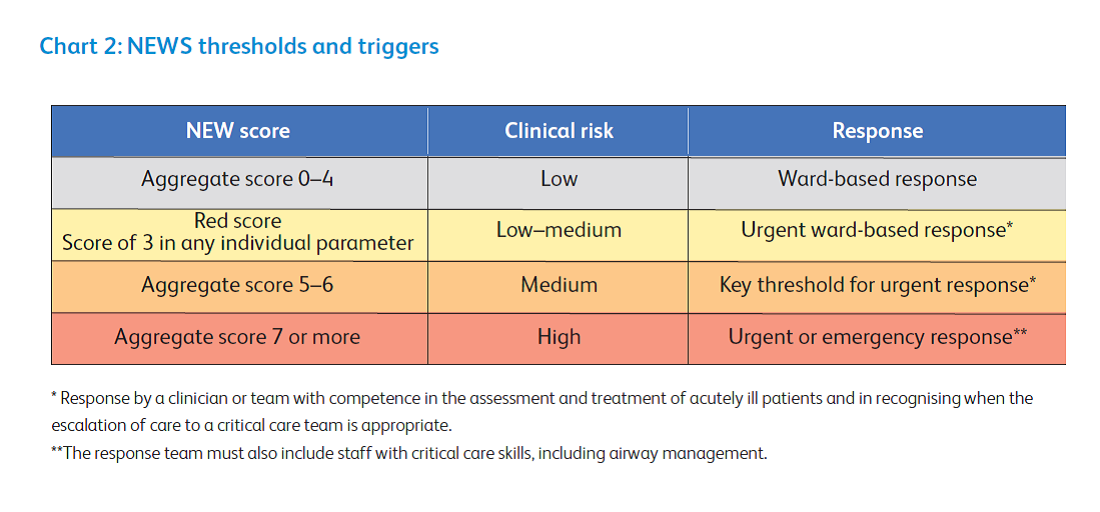
NEWS score should be documented in the data journal under its own heading. NEWS score >5 should be followed by a comment and action, which is a doctor’s order.
Monitoring of vital parameters with NEWS
| Physiological parameters | 3 | 2 | 1 | 0 | 1 | 2 | 3 |
|---|---|---|---|---|---|---|---|
| Respiratory rate | ≤ 8 | 9-11 | 12-20 | 21-24 | ≥ 25 | ||
| Oxygenation | ≤ 91 | 92-93 | 94-95 | ≥ 96 | |||
| Oxygen supply | Ja | Nej | |||||
| Temperature | ≤ 35.0 | 35.1-36.0 | 36.1-38.0 | 38.1-39.0 | ≥ 39.1 | ||
| Systolic blood pressure | ≤ 90 | 91-100 | 101-110 | 111-219 | ≥ 220 | ||
| Heart rate/pulse | ≤ 40 | 41-50 | 51-90 | 91-110 | 111-130 | ≥ 131 | |
| Level of consciousness | A | V, P or U |
Patient Discharge
Considerations for Discharging Nurses and Doctors:
- Plan early for discharge
- Identify the greatest safety risk for each patient before discharge and document the risk in the composite status
- Ensure that orders are effective in the ward
- Always ask if the ward staff can come to the intensive care unit and receive the patient report there?
- Report the patient at the agreed place, to the responsible nurse and assistant nurse
- ICU patients should preferably be transported by healthcare staff

What is Needed for the Patient to be Discharged from ICU?
Below are a number of points to consider before discharging an intensive care patient.
What is the greatest safety risk for the patient? How can we reduce any risks for the patient?
Communication: GCS grade? Is there a functioning language and communication? Aids, need for an interpreter?
Respiration: Airway obstruction? Oxygen requirement? PEP valve, secretion stagnation, cough strength?
Circulation: Hemodynamically stable? Recently discontinued inotropic support? Fluid balance, any drain losses, signs of sepsis? Heart failure?
Nutrition: Calorie needs? TPN, EN? Gastric retention, nausea?
Elimination: Kidney function, fluid balance, functioning bowel regimen?
Skin: Insertion sites? Wounds, ports, and any surgical incisions? In and out routes, can anything be removed? Pressure injury? Arterial catheter?
Mobilization/Activity: Degree of mobilization, what can the patient do on their own? Can the patient sit up, stand, or walk on their own?
Sleep: Circadian rhythm? Residual effect of sedatives? Need for sleeping aids?
Pain: VAS, optimal pain relief? Epidural catheter or other regional anesthesia? Protocol to fill in?
Mental Status: Fully awake? ICU delirium, withdrawal? Anxiety, nightmares? Need for social worker contact?
Relatives: Information about the course of care and transfer to the ward? Need for support, social worker contact, doctor’s consultation, need for visits? Medical certificate?
Documentation: Is all necessary documentation and registration complete? SIR register? Medical journal.
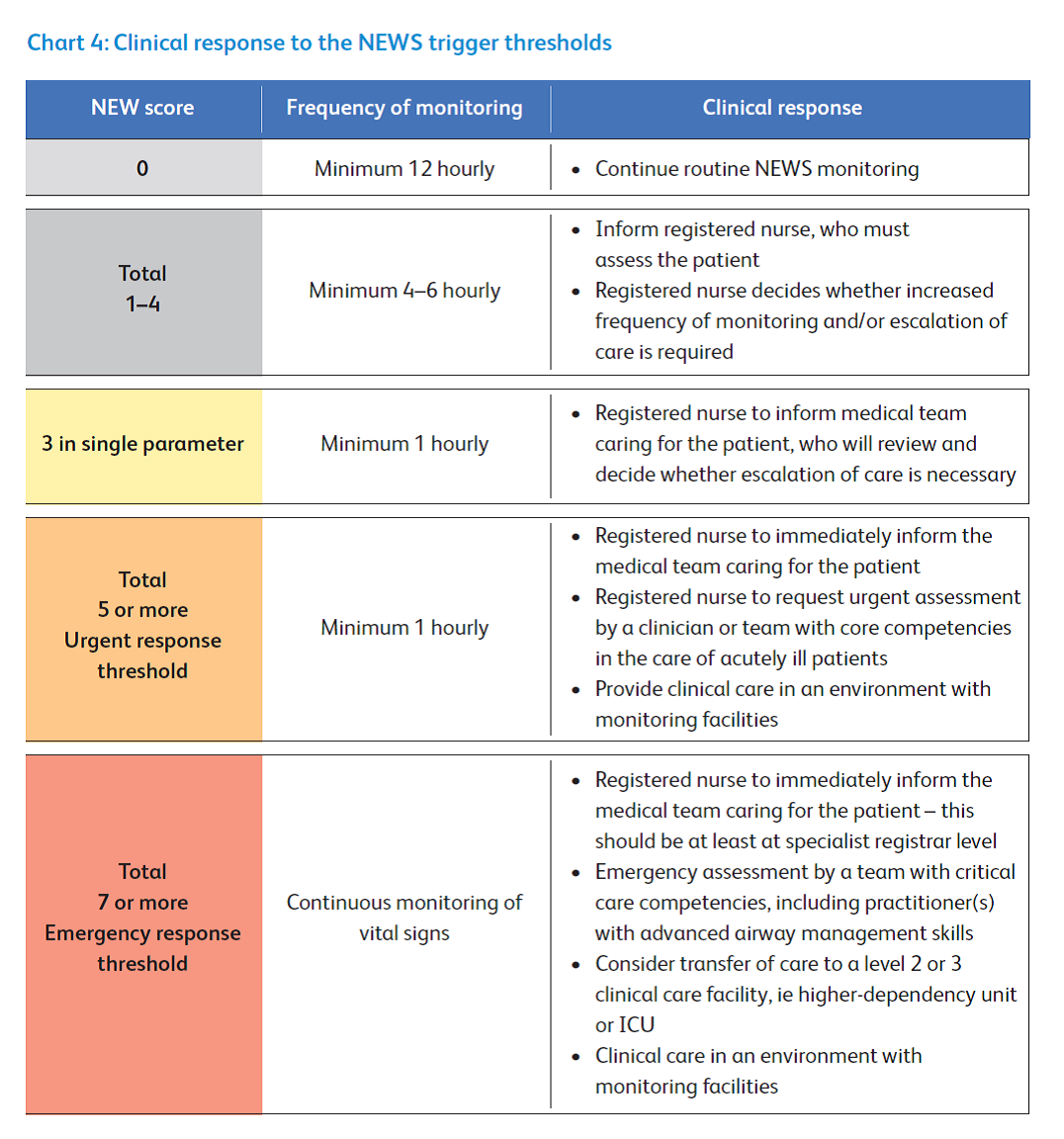
NOTE: National Early Warning Score (NEWS) over 5? NEWS score >5 should be followed by a comment and action, which is a doctor’s order.
news2-chart-1_the-news-scoring-system_0_0
NEWS
The NEWS is based on a simple aggregate scoring system in which a score is allocated to physiological measurements, already recorded in routine practice, when patients present to, or are being monitored in hospital. Six simple physiological parameters form the basis of the scoring system:
- Respiration rate
- Oxygen saturation
- Systolic blood pressure
- Pulse rate
- Level of consciousness or new confusion*
- Temperature.
*The patient has new-onset confusion, disorientation and/or agitation, where previously their mental state was normal – this may be subtle. The patient may respond to questions coherently, but there is some confusion, disorientation and/or agitation. This would score 3 or 4 on the GCS (rather than the normal 5 for verbal response), and scores 3 on the NEWS system.
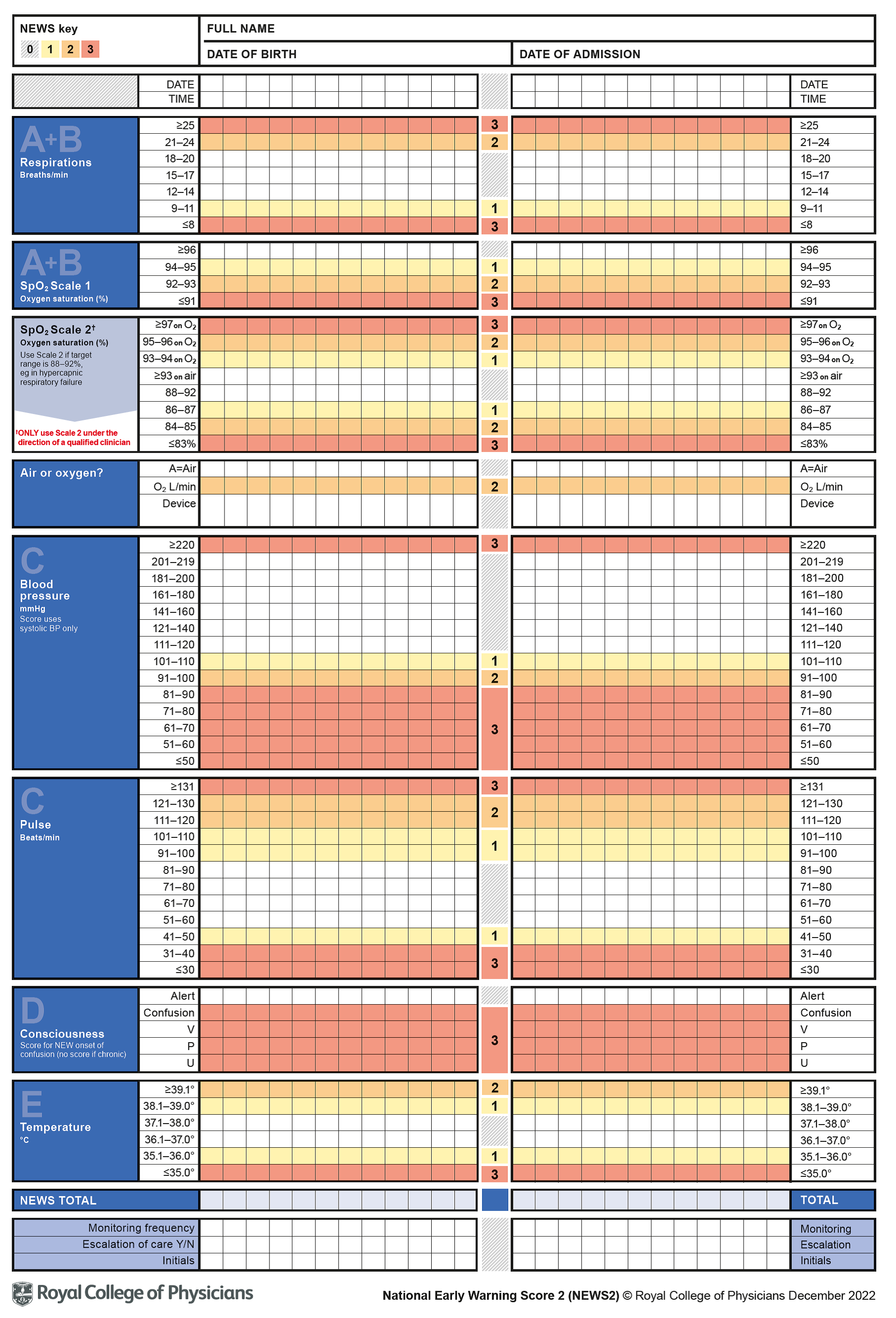
A score is allocated to each parameter as they are measured, with the magnitude of the score reflecting how extremely the parameter varies from the norm. The score is then aggregated and uplifted by 2 points for people requiring supplemental oxygen to maintain their recommended oxygen saturation.
This is a pragmatic approach, with a key emphasis on system-wide standardisation and the use of physiological parameters that are already routinely measured in hospitals and in prehospital care, recorded on a standardised clinical chart – the NEWS2 chart.
Reproduced from: Royal College of Physicians. National Early Warning Score (NEWS) 2: Standardising the assessment of acute-illness severity in the NHS. Updated report of a working party. London: RCP, 2017.
news2-chart-1_the-news-scoring-system_0_0
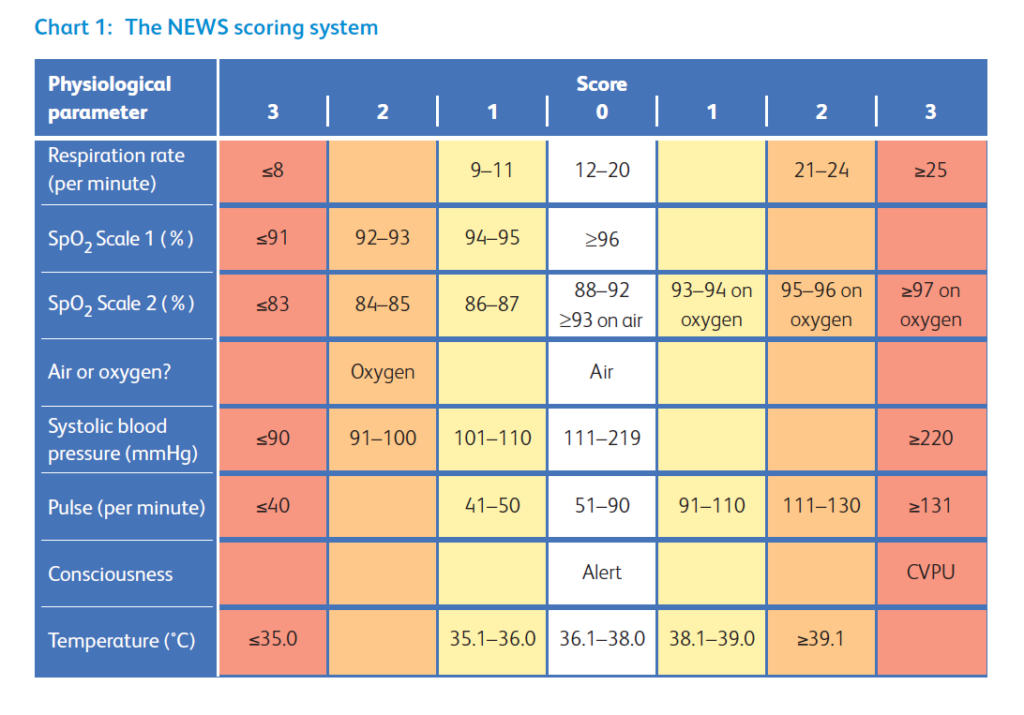
The NEWS Scoring System
| Physiological parameter | |||||||
|---|---|---|---|---|---|---|---|
| 3 | 2 | 1 | 0 | 1 | 2 | 3 | |
| Respiration rate (per minute) | ≤8 | 9–11 | 12–20 | 21–24 | ≥25 | ||
| SpO2 Scale 1 (%) | ≤91 | 92–93 | 94–95 | ≥96 | |||
| SpO2 Scale 2 (%) | ≤83 | 84–85 | 86–87 | 88–92 ≥93 on air | 93–94 on oxygen | 95–96 on oxygen | ≥97 on oxygen |
| Air or oxygen? | Oxygen | Air | |||||
| Systolic blood pressure (mmHg) | ≤90 | 91–100 | 101–110 | 111–219 | ≥220 | ||
| Pulse (per minute) | ≤40 | 41–50 | 51–90 | 91–110 | 111–130 | ≥131 | |
| Consciousness | Alert | * CVPU | |||||
| Temperature (°C) | ≤35.0° | 35.1–36.0° | 36.1–38.0° | 38.1–39.0° | ≥39.1° | ||
Diagnosis List for Registration According to SIR within Intensive Care in Sweden
This document contains ICD-10-SE diagnoses for:
a) Common diagnoses in general intensive care and thoracic intensive care (ICU and TIVA)
b) Common diagnoses in pediatric intensive care (PICU).
Some comments regarding these so-called ICU diagnoses:
The primary goal of using these diagnoses is to describe, in a nationally coordinated manner, which patients are subject to Swedish intensive care. This requires uniform use, which is why the scope of diagnoses has been strongly limited. In addition, there are several diagnoses that may be of interest to follow, perhaps primarily diagnoses that we know or suspect have significance for the prognosis even if they do not constitute the primary reason for intensive care – for example, malignancy or renal insufficiency. To handle this, each care occasion should be provided with a “Primary ICU diagnosis” from the list below. If necessary, multiple ICU diagnoses from the list can be specified, but only one can be the primary ICU diagnosis. In addition to these, appropriate other ICD-10-SE diagnoses that are relevant to intensive care can be specified. These diagnoses, which are not in SIR’s diagnosis list, can never be the primary ICU diagnosis.
Guide for Diagnosis Registration According to SIR
Please use the search function to find the correct diagnosis and diagnosis number.

Key for diagnosis according to SIR version 16
| List of diagnoses for registration according to SIR |
|---|
| A) Diagnoses for care type ICU and ThICU, coding according to ICD-10-SE |
| Infectious diseases, infection-triggered conditions, infectious agents, antibiotic resistance. * If criteria for severe sepsis or septic shock are met, R65.1 or R57.2 is also indicated. * In the case of infection, the verified infectious agent is indicated according to the code list below (see under heading: "B. Other infectious agents"). Ev. antibiotic resistance is additionally coded with "U codes" (see under heading: "C. Antibiotic resistance"). |
| A. Certain infection-related diseases |
| A04.7 Enterokolit orsakad av Clostridium difficile * |
| A09.9 Gastroenterit och kolit av infektiös och ospecificerad orsak (se även K52.9) * |
| A16.2 Lungtuberkulos * |
| A48.0 Gasgangrän. Klostridiecellulit * |
| A49.9 Bakterieinfektion, ospecificerad * |
| A87.9 Virusmeningit, ospecificerad |
| B00.4 Encefalit orsakad av herpes simplex-virus |
| B19.9 Virushepatit |
| B20.9 HIV-infektion |
| B34.9 Virusinfektion, ospecificerad |
| B37.7 Candidaseptikemi * |
| B49.9 Svampinfektion UNS * |
| B54.9 Malaria * |
| B59.9 Pneumocystis carinii-infektion * |
| B99.9 Andra infektionssjukdomar, lokalisation ej specificerad * |
| D59.3 Hemolytiskt-uremiskt syndrom |
| G00.9 Meningit, bakteriell * |
| G03.9 Meningit, ospecificerad * |
| G04.9 Encefalit, myelit och encefalomyelit, ospecificerad * |
| G06.0 Intrakraniell abscess * |
| G06.1 Intraspinal abscess. Epidural abscess * |
| I26.0 Lungemboli med uppgift om akut cor pulmonale |
| I26.9 Lungemboli utan uppgift om akut cor pulmonale |
| I33.0 Endokardit, akut och subakut, infektiös * |
| J04.2 Laryngotrakeit, akut * |
| J05.1 Epiglottit, akut * |
| J09.9 Influensa orsakad av pandemisk influensa |
| J10.0 Influensa med pneumoni, säsongsinfluensa |
| J10.1 Influensa med andra respiratoriska manifestationer, säsongsinfluensa |
| J10.8 Influensa med andra manifestationer, säsongsinfluensa |
| J12.1 RS-viruspneumoni |
| J12.9 Viruspneumoni, ospecificerad |
| J15.9 Pneumoni, bakteriell * |
| J86.9 Empyem * |
| J98.5 Mediastinit * |
| K12.2 Inflammation och abscess i munregionen * |
| K65.0 Peritonit, akut. Bukabscess * |
| K81.9 Kolecystit * |
| K83.0 Kolangit * |
| L08.9 Infektion i hud och underhud * |
| M00.9 Artrit, infektiös * |
| M72.6 Nekrotiserande fasciit * |
| M86.9 Osteomyelit. Infektion i benvävnad * |
| N10.9 Pyelonefrit, akut. Pyelit, akut * |
| N39.0 Urinvägsinfektion, ospecificerad. Urosepsis * |
| R57.2 Septisk chock. Anges om definierade kriterier (se riktlinjer för diagnossättning) är uppfyllda och bör kompletteras med kod för infektionstyp och eventuellt verifierat infektiöst agens |
| R65.1 Svår sepsis. Anges om definierade kriterier (se riktlinjer för diagnossättning) är uppfyllda och bör kompletteras med kod för infektionstyp och eventuellt verifierat infektiöst agens |
| T79.3 Posttraumatisk sårinfektion * |
| T81.4 Infektion efter kirurgiska och medicinska ingrepp. CNS-infektion, postoperativ * , Nosokomial infektion UNS* |
| T85.7 Ventrikeldrän-associerad meningit * |
| B. Övriga infektiösa agens |
| A32.9 Listeria |
| A39.9 Meningokocker |
| A48.1 Legionella |
| A69.2 Borrelia |
| A74.9 Klamydia |
| B95.0 Streptokocker grupp A |
| B95.1 Streptokocker grupp B |
| B95.2 Enterokocker, Streptokocker grupp D |
| B95.3 Pneumokocker (Streptococcus pneumonie) |
| B95.5 Streptokocker övriga och ej specificerade |
| B95.6 Staphylococcus aureus |
| B95.7 Koagulasnegativa stafylokocker, KNS |
| B96.0 Mycoplasma |
| B96.1 Klebsiella |
| B96.2 Escherichia coli |
| B96.3 Haemophilus influenzae |
| B96.4 Proteus (mirabilis) (morgagni) |
| B96.5 Pseudomonas (aeruginosa). Stenotropomonas maltophilia |
| B96.8B Acinetobacter |
| B96.8 Övriga verifierade bakterier |
| C. Antibiotikaresistens ( "U" koden skrivs in direkt efter aktuell bakteriekod) |
| U82.1 Methicillinresistens, MRSA (methicillinresistenta staph. aureus ) |
| U82.2 Extended spectrum betalactamase resistance (ESBL) |
| U83.0 Vancomycinresistens, VRE, VRSA (vancomycinresistenta enterokocker resp. staph. aureus) |
| U83.9 Antibiotikaresistens UNS |
| U84.3 Resistens mot tuberkulostatika |
| Tumörer |
| C72.9 Malign tumör i centrala nervsystemet |
| C80.9 Malign tumör utan specificerad lokalisation |
| C96.9 Primär, malign tumör i lymfoid, blodbildande och besläktad vävnad, ospecificerad |
| D33.9 Benign tumör i centrala nervsystemet |
| D36.9 Benign tumör utan specificerad lokalisation |
| D43.9 Tumör av osäker eller okänd natur i centrala nervsystemet |
| D48.9 Tumör av osäker eller okänd natur utan specificerad lokalisation |
| Blod och blodbildande organ |
| C96.9 Primär, malign tumör i lymfoid, blodbildande och besläktad vävnad, ospecificerad |
| D59.3 Hemolytiskt-uremiskt syndrom |
| D68.9 Koagulationsrubbning |
| D75.9 Sjukdom i blod och blodbildande organ |
| Vissa rubbningar i immunsystemet |
| D84.9 Immunbrist |
| Endokrina och metabola sjukdomar |
| E03.5 Myxödemkoma |
| E05.5 Tyreotoxisk kris |
| E10.8 Diabetes mellitus typ 1 med icke specificerade komplikationer |
| E11.8 Diabetes mellitus typ 2 med icke specificerade komplikationer |
| E14.0 Diabetes UNS med koma pga. hypo- eller hyperglykemi. Diabetiskt hyperosmolärt koma |
| E14.1 Diabetes med ketoacidos |
| E21.3 Hyperparatyreoidism |
| E22.2 Abnorm sekretion av antidiuretiskt hormon (SIADH) |
| E23.0 Hypopituitarism. Sheehans syndrom |
| E23.2 Diabetes insipidus (ej nefrogen diabetes insipidus) |
| E27.4 Binjurebarksinsufficiens |
| E34.0 Karcinoidsyndrom |
| E43.9 Svår undernäring |
| E66.9 Fetma |
| E80.2 Porfyri, akut intermittent |
| E84.9 Cystisk fibros |
| Vätska/Elektrolyt/Syra-Bas rubbningar |
| E86.9 Hypovolemi, dehydrering (ej med chock) |
| E87.0 Hyperosmolalitet och/eller hypernatremi |
| E87.1 Hypoosmolalitet och/eller hyponatremi (ej SIADH) |
| E87.2 Acidos, metabol eller respiratorisk (ej diabetesketoacidos) |
| E87.3 Alkalos, metabol eller respiratorisk |
| E87.5 Hyperkalemi |
| E87.6 Hypokalemi |
| E87.7 Ökad vätskevolym |
| E87.8 Elektrolyt och/eller vätskebalansrubbning, ospecificerad |
| Chock |
| A48.3 Toxic shock syndrome, TSS * |
| R57.0 Kardiogen chock |
| R57.1 Hypovolemisk chock |
| R57.2 Septisk chock. Anges om definierade kriterier (se riktlinjer för diagnossättning) är uppfyllda och bör kompletteras med kod för infektionstyp och eventuellt verifierat infektiöst agens |
| R65.1 Svår sepsis. Anges om definierade kriterier (se riktlinjer för diagnossättning) är uppfyllda och bör kompletteras med kod för infektionstyp och eventuellt verifierat infektiöst agens |
| T78.2 Anafylaktisk chock, Allergisk chock. Anafylaxi UNS |
| T81.1 Chock under eller som följd av kirurgiska och medicinska ingrepp som ej klassificeras annorstädes |
| Psykiska sjukdomar / beteendestörningar |
| R41.0 Desorientering. Konfusion, UNS |
| F05.9 Delirium/konfusion uppkommen på IVA "IVA syndrom" |
| F10.4 Delirium tremens (alkoholutlöst) |
| F29.9 Psykos UNS (ej uppkommen på IVA) |
| F32.9 Depressiv episod |
| Sjukdomar i nervsystemet |
| Cerebrovaskulära sjukdomar återfinnes under Cirkulationsorganens sjukdomar |
| A87.9 Virusmeningit, ospecificerad |
| B00.4 Encefalit orsakad av herpes simplex-virus |
| C72.9 Malign tumör i centrala nervsystemet |
| D33.9 Benign tumör i centrala nervsystemet |
| D43.9 Tumör av osäker eller okänd natur i centrala nervsystemet |
| G00.9 Meningit, bakteriell * |
| G03.9 Meningit, ospecificerad * |
| G04.9 Encefalit, myelit och encefalomyelit, ospecificerad * |
| G06.0 Intrakraniell abscess * |
| G06.1 Intraspinal abscess. Epidural abscess * |
| G12.2 Amyotrofisk lateralskleros(ALS) |
| G35.9 Multipel skleros |
| G41.9 Status epileptikus |
| G61.0 Guillain-Barrés syndrom |
| G70.0 Myasthenia gravis |
| G71.9 Primär muskelsjukdom |
| G83.9 Förlamningssyndrom. Reserveras för "Critical illness, polyneuropati/myopati" |
| G91.9 Hydrocefalus |
| G93.1 Anoxisk / hypoxisk cerebral skada |
| G93.5 Hjärnkompression/inklämning (ej traumatisk) |
| G93.6 Hjärnödem (ej traumatiskt) |
| G93.8 Total hjärninfarkt |
| G95.2 Ryggmärgskompression, ospecificerad |
| G95.9 Sjukdom i ryggmärgen |
| G98.9 Sjukdom i nervsystemet UNS |
| R40.0 Somnolens. Sänkt vakenhetsgrad |
| R40.2 Koma. Medvetslöshet |
| R41.0 Desorientering. Konfusion, UNS |
| R52.9 Smärta eller värk, ospecificerad |
| R55.9 Svimning och kollaps (ej Adam-Stokes-attack) |
| R56.0 Feberkramper |
| R56.8 Kramper, UNS |
| T85.0 Shuntdysfunktion |
| T85.7 Ventrikeldrän-associerad meningit * |
| Cirkulationsorganens sjukdomar |
| I10.9 Hypertoni |
| I20.9 Angina pectoris |
| I21.9 Hjärtinfarkt (< 28 dagar från symtomdebut) |
| I22.9 Reinfarkt inom 28 dagar från första symtomdebut |
| I24.1 Postinfarktsyndrom, PMI-syndrom |
| I26.9 Emboli/Trombos i lungartär (ej obstetrisk) |
| Andningsorganens sjukdomar |
| A16.2 Lungtuberkulos * |
| J04.2 Laryngotrakeit, akut * |
| J05.0 Pseudokrupp |
| J05.1 Epiglottit, akut * |
| J12.1 RS-viruspneumoni |
| J12.9 Viruspneumoni, ospecificerad |
| J15.9 Pneumoni, bakteriell * |
| J38.4 Larynxödem |
| J44.9 Kronisk obstruktiv lungsjukdom (KOL). |
| J46.9 Akut svår astma |
| J69.0 Aspirationspneumoni pga maginnehåll/föda |
| J80.9 ARDS |
| J80.9A Lätt ARDS |
| J80.9B Måttlig ARDS |
| J80.9C Svår ARDS |
| J80.9X ARDS utan uppgift om svårighetsgrad |
| J81.9 Lungödem, ospecificerat ( ej kardiellt) |
| J84.1 Lungsjukdom med fibros, lungfibros |
| J86.9 Empyem * |
| J93.9 Pneumotorax (ej traumatisk) |
| J94.8 Hydrothorax |
| J95.0 Dysfunktion av trakeostomi |
| J95.1 Akut respiratorisk insufficiens efter toraxkirurgi |
| J95.2 Akut respiratorisk insufficiens efter icke torakal kirurgi |
| J95.8A Ventilatorassocierad pneumoni (VAP) |
| J96.9 Respiratorisk insufficiens, ospecificerad |
| J98.1 Atelektas |
| J98.5 Mediastinit * |
| P25.1 Pneumotorax under den perinatala perioden |
| P28.8 Stridor, medfödd (laryngeal) |
| R04.9 Blödning från luftvägarna |
| R06.1 Stridor, ej medfödd |
| R09.0 Asfyxi |
| R09.2 Andningsstillestånd |
| S27.0 Pneumotorax, traumatisk |
| Matsmältningsorganens sjukdomar |
| A04.7 Enterokolit orsakad av Clostridium difficile * |
| A09.9 Gastroenterit och kolit av infektiös och ospecificerad orsak (se även K52.9) * |
| I85.0 Esofagusvaricer med blödning |
| I85.9 Esofagusvaricer utan blödning |
| K12.2 Inflammation och abscess i munregionen * |
| K22.3 Esofagusruptur/perforation |
| K25.1 Sår i magsäcken, akut med perforation |
| K27.9 Sår i magsäck eller tolvfingertarm |
| K46.0 Bukbråck, inklämt utan gangrän |
| K46.1 Bukbråck, med gangrän |
| K52.9 Icke infektiös gastroenterit och kolit. Se även A09.9 |
| K55.0 Akuta kärlsjukdomar i tarmen. Tarmischemi. Trombos / emboli |
| K56.7 Ileus |
| K63.1 Perforation (icke traumatisk) av tarmen |
| K65.0 Peritonit, akut. Bukabscess * |
| K72.9 Leversvikt |
| K81.9 Kolecystit * |
| K83.0 Kolangit * |
| K85.9 Pankreatit, akut |
| K92.2 Gastrointestinal blödning, ospecificerad |
| R10.4 Buksmärtor, ospecificerade |
| R18.9 Ascites |
| R19.8A Bukkompartmentsyndrom |
| Hudens sjukdomar |
| L08.9 Infektion i hud och underhud * |
| L27.0 Generaliserad hudreaktion orsakad av läkemedel |
| L89.9 Trycksår |
| L98.9 Sjukdom i hud och underhud, ospecificerad |
| Sjukdomar i muskuloskeletala systemet och bindväven |
| M00.9 Artrit, infektiös * |
| M41.9 Skolios |
| M72.6 Nekrotiserande fasciit * |
| M86.9 Osteomyelit. Infektion i benvävnad * |
| Urinorganens sjukdomar |
| D59.3 Hemolytiskt-uremiskt syndrom |
| N10.9 Pyelonefrit, akut. Pyelit, akut * |
| N17.9 Akut njursvikt |
| N18.9 Kronisk njursvikt |
| N25.1 Nefrogen diabetes insipidus |
| N39.0 Urinvägsinfektion, ospecificerad. Urosepsis * |
| Kvinnliga bäcken-/könsorganens sjukdomar |
| N93.9 Onormal blödning från uterus och vagina, ospecificerad |
| Graviditet/Förlossning/Barnsängstid |
| O14.1 HELLP-syndrom |
| O14.9 Preeklampsi |
| O15.9 Eklampsi |
| O72.3 Blödning, post-partum |
| O88.1 Fostervattenemboli |
| O88.2 Lungemboli under barnsängstiden UNS |
| O99.4 Sjukdomar i cirkulationsorganen hos modern som komplicerar graviditet, förlossning och barnsängstid |
| O99.5 Sjukdomar i andningsorganen hos modern som komplicerar graviditet, förlossning och barnsängstid |
| Vissa perinatala tillstånd |
| P21.9 Asfyxi vid förlossningen, ospecificerad |
| P22.0 Respiratory distress syndrome hos nyfödd, IRDS |
| P24.0 Mekoniumaspiration hos nyfödd |
| P25.1 Pneumotorax under den perinatala perioden |
| P27.1 Bronkopulmonell dysplasi under den perinatala perioden |
| P28.2 Cyanosattacker hos nyfödd |
| P28.4 Apné hos nyfödd |
| P28.8 Stridor, medfödd (laryngeal) |
| R95.9 Plötslig spädbarnsdöd |
| Medfödda missbildningar |
| Q07.9 Medfödd missbildning i nervsystemet |
| Q18.9 Medfödd missbildning av ansiktet och halsen |
| Q24.9 Medfödd hjärtmissbildning, ospecificerad |
| Q34.9 Medfödd missbildning av andningsorganen |
| Q45.9 Medfödd missbildning av matsmältningsorganen, ospecificerad |
| Q64.9 Medfödd missbildning av urinorganen, ospecificerad |
| Q79.0 Medfött diafragmabråck |
| Q79.9 Medfödd missbildning av muskler och skelett, ospecificerad |
| Q89.9 Medfödd missbildning, ospecificerad |
| Trauma |
| S01.9 Sårskada på huvudet |
| S02.1 Fraktur på skallbasen |
| S02.9 Fraktur på skalle och ansiktsben. |
| S06.0 Hjärnskakning. Commotio cerebri |
| S06.1 Hjärnödem, traumatiskt |
| S06.2 DAI. Diffus kontusion/laceration |
| S06.3 Fokal cerebral kontusion |
| S06.4 Epidural blödning, traumatisk |
| S06.5 Subdural blödning, traumatisk |
| S06.6 Subaraknoidal blödning, traumatisk |
| S06.9 Intrakraniell skada, ospecificerad (används för alla skallskador utom S06.0) |
| S12.9 Fraktur på halskota / halskotpelaren |
| S14.1 Ryggmärgsskada, cervikal nivå |
| S15.9 Skada på blodkärl i halsregionen |
| S22.0 Fraktur på bröstkotpelaren |
| S22.2 Fraktur på sternum |
| S22.4 Multipla frakturer på revben |
| S24.1 Ryggmärgsskada, thorakal nivå |
| S25.9 Kärlskada på bröstkorgsnivå |
| S26.9 Hjärtkontusion |
| S27.0 Pneumotorax, traumatisk |
| S27.1 Hemotorax, traumatisk |
| S27.3 Lungkontusion |
| S32.8 Fraktur på bäcken / ländkotpelare |
| S34.1 Ryggmärgsskada, lumbal/sacral nivå |
| S35.9 Kärlskada på buknivå / bäckennivå |
| S36.9 Skada på icke specificerat organ i buken |
| S37.9 Skada på icke specificerat bäckenorgan |
| S72.0 Höftfraktur |
| T07.9 Multipla skador. Multitrauma UNS |
| T10.9 Fraktur, övre extremitet |
| T11.9 Annan skada övre extremiteten |
| T12.9 Fraktur, nedre extremitet ospecificerad |
| T13.9 Annan skada nedre extremiteten |
| T14.1A Bett av djur, ospecificerat |
| T14.9 Skada, ospecificerad |
| T79.2 Posttraumatisk blödning |
| Främmande kropp |
| T17.9 Främmande kropp i andningsvägarna |
| T18.1 Främmande kropp i esofagus |
| T18.9 Främmande kropp i matsmältningsorganen |
| Bränn-/Frätskada |
| T27.3 Brännskada i andningsvägarna |
| T27.7 Frätskada i andningsvägarna |
| T30.0 Brännskada UNS |
| T30.4 Frätskada UNS |
| Köldskada |
| T35.7 Köldskada |
| T68.9 Hypotermi, accidentell (ej hypotermi orsakad av anestesi) |
| Förgiftning |
| F10.0 Alkoholintoxikation, akut |
| F13.0 Intoxikation med GHB eller närbesläktade medel |
| T39.0 Salicylater |
| T39.1 Paracetamol. Anilider |
| T39.3 NSAID |
| T40.1 Heroin |
| T40.2 Opiater, opioider |
| T40.6 Andra och icke specificerade narkotiska medel |
| T40.7 Cannabis |
| T41.4 Anestetikum, ospecificerat |
| T42.3 Barbiturater |
| T42.4 Bensodiazepiner eller bensodiazepinlika sedativa/hypnotika |
| T42.7 Antiepileptika, lugnande medel och sömnmedel, ospecificerade |
| T43.0 Tricykliska och tetracykliska antidepressiva läkemedel |
| T43.2 Andra och icke specificerade antidepressiva läkemedel. Används för SSRI-intoxikationer |
| T43.5 Neuroleptika och antipsykotiska läkemedel |
| T43.6 Psykostimulantia med missbruksrisk |
| T43.9 Psykotropt medel, ospecificerat |
| T44.7 Beta-receptorblockerare |
| T45.5 Antikoagulantia |
| T46.0 Hjärtstimulerande glykosider och läkemedel med liknande verkan |
| T46.1 Kalciumantagonister |
| T51.1 Metanol |
| T51.2 Isopropylalkohol |
| T52.3 Glykoler |
| T52.9 Organiskt lösningsmedel, ospecificerat |
| T54.9 Frätande substans, ospecificerad |
| T57.3 Cyanväte |
| T58.9 Toxisk effekt av kolmonoxid |
| T59.9 Gaser, rök och ångor, ospecificerade |
| T63.0 Toxisk effekt av ormgift |
| T63.4 Insektsbett eller stick, giftigt |
| T65.9 Förgiftning, ospecificerad |
| Z03.6 Observation för misstänkt toxisk effekt av intagen substans |
| Andra effekter av yttre orsaker |
| T14.1A Bett av djur, ospecificerat |
| T67.0 Värmeslag och solsting |
| T68.9 Hypotermi, accidentell (ej hypotermi orsakad av anestesi) |
| T70.2 Barotrauma UNS. Lungbristning |
| T70.3 Dykarsjuka |
| T71.9 Kvävning/strypning (ej kolmonoxid, T58.9) |
| T74.9 Misshandelssyndrom, barnmisshandel |
| T75.0 Effekter av blixtnedslag |
| T75.1 Drunkning och drunkningstillbud |
| T75.4 Effekter av elektrisk ström |
| T78.2 Anafylaktisk chock, Allergisk chock. Anafylaxi U |
| B) Diagnoser för vårdtyp BIVA, kodning enligt ICD-10-SE |
| Infektionssjukdomar, infektionsutlösta tillstånd, infektiösa agens, antibiotikaresistens * Om kriterier för svår sepsis eller septisk chock är uppfyllda anges även R65.1 eller R57.2. * Vid infektion anges verifierat infektiöst agens enligt kodlista nedan (se under rubrik: "B. Övriga infektiösa agens"). Ev. antibiotikaresistens tilläggskodas med "U-koder " (se nedan). |
| A. Vissa infektionsrelaterade sjukdomar |
| A09.9 Gastroenterit och kolit av infektiös och ospecificerad orsak (se även K52.9) * |
| A37.0 Kikhosta |
| A49.9 Bakterieinfektion, ospecificerad * |
| A87.9 Virusmeningit, ospecificerad |
| B34.9 Virusinfektion, ospecificerad |
| B99.9 Andra infektionssjukdomar, lokalisation ej specificerad * |
| D59.3 Hemolytiskt-uremiskt syndrom |
| G00.9 Meningit, bakteriell * |
| G04.9 Encefalit, myelit och encefalomyelit, ospecificerad * |
| I33.0 Endokardit, akut och subakut, infektiös * |
| J05.1 Epiglottit, akut * |
| J06.9 Övre luftvägsinfektion, akut |
| J09.9 Influensa orsakad av pandemisk influensa |
| J10.0 Influensa med pneumoni, säsongsinfluensa |
| J10.1 Influensa med andra respiratoriska manifestationer, säsongsinfluensa |
| J10.8 Influensa med andra manifestationer, säsongsinfluensa |
| J12.1 RS-viruspneumoni |
| J12.9 Viruspneumoni, ospecificerad |
| J15.9 Pneumoni, bakteriell * |
| J20.9 Bronkit, akut |
| J85.2 Lungabscess * |
| J85.3 Abscess i mediastinum * |
| J98.5 Mediastinit * |
| K12.2 Inflammation och abscess i munregionen * |
| K65.0 Peritonit, akut. Bukabscess * |
| R57.2 Septisk chock. Anges om definierade kriterier (se riktlinjer för diagnossättning) är uppfyllda och bör kompletteras med kod för infektionstyp och eventuellt verifierat infektiöst agens |
| R65.1 Svår sepsis. Anges om definierade kriterier (se riktlinjer för diagnossättning) är uppfyllda och bör kompletteras med kod för infektionstyp och eventuellt verifierat infektiöst agens |
| T81.4 Infektion efter kirurgiska och medicinska ingrepp. CNS-infektion, postoperativ * , Nosokomial infektion UNS* |
| T85.7 Ventrikeldrän-associerad meningit * |
| B. Övriga infektiösa agens |
| A32.9 Listeria |
| A39.9 Meningokocker |
| A48.1 Legionella |
| A69.2 Borrelia |
| A74.9 Klamydia |
| B95.0 Streptokocker grupp A |
| B95.1 Streptokocker grupp B |
| B95.2 Enterokocker, Streptokocker grupp D |
| B95.3 Pneumokocker (Streptococcus pneumonie) |
| B95.5 Streptokocker övriga och ej specificerade |
| B95.6 Staphylococcus aureus |
| B95.7 Koagulasnegativa stafylokocker, KNS |
| B96.0 Mycoplasma |
| B96.1 Klebsiella |
| B96.2 Escherichia coli |
| B96.3 Haemophilus influenzae |
| B96.4 Proteus (mirabilis) (morgagni) |
| B96.5 Pseudomonas (aeruginosa). Stenotropomonas maltophilia |
| B96.8B Acinetobacter |
| B96.8 Övriga verifierade bakterier |
| C. Antibiotikaresistens ( "U" koden skrivs in direkt efter aktuell bakteriekod) |
| U82.1 Methicillinresistens, MRSA (methicillinresistenta staph. aureus ) |
| U82.2 Extended spectrum betalactamase resistance (ESBL) |
| U83.0 Vancomycinresistens, VRE, VRSA (vancomycinresistenta enterokocker resp. staph. aureus) |
| U83.9 Antibiotikaresistens UNS |
| U84.3 Resistens mot tuberkulostatika |
| Tumörer |
| C80.9 Malign tumör utan specificerad lokalisation |
| C96.9 Primär, malign tumör i lymfoid, blodbildande och besläktad vävnad, ospecificerad |
| D36.9 Benign tumör utan specificerad lokalisation |
| D48.9 Tumör av osäker eller okänd natur utan specificerad lokalisation |
| Blod och blodbildande organ |
| C96.9 Primär, malign tumör i lymfoid, blodbildande och besläktad vävnad, ospecificerad |
| D59.3 Hemolytiskt-uremiskt syndrom |
| D68.9 Koagulationsrubbning |
| D75.9 Sjukdom i blod och blodbildande organ |
| Vissa rubbningar i immunsystemet |
| D82.1 CATCH 22 /Di Georges syndrom |
| D84.9 Immunbrist |
| Endokrina och metabola sjukdomar |
| E14.1 Diabetes med ketoacidos |
| E34.9 Endokrin rubbning |
| E43.9 Svår undernäring |
| E84.9 Cystisk fibros |
| Vätska/Elektrolyt/Syra-Bas rubbningar |
| E87.8 Elektrolyt och/eller vätskebalansrubbning, ospecificerad |
| E88.9 Ämnesomsättningsrubbningar (inborn error of metabolism) |
| R57.1 Hypovolemisk chock |
| Psykiska sjukdomar/beteendestörningar |
| F05.9 Delirium/konfusion uppkommen på IVA "IVA syndrom" |
| F79.0 Psykisk utvecklingsstörning |
| F83.9 Motorisk utvecklingsstörning |
| Sjukdomar i nervsystemet |
| A87.9 Virusmeningit, ospecificerad |
| G00.9 Meningit, bakteriell * |
| G04.9 Encefalit, myelit och encefalomyelit, ospecificerad * |
| G12.9 Spinal muskelatrofi |
| G41.9 Status epileptikus |
| G71.0 Muskeldystrofi |
| G71.9 Primär muskelsjukdom |
| G80.9 Cerebral pares |
| G83.9 Förlamningssyndrom. Reserveras för "Critical illness, polyneuropati/myopati" |
| G91.9 Hydrocefalus |
| G93.5 Hjärnkompression/inklämning (ej traumatisk) |
| G93.8 Total hjärninfarkt |
| G98.9 Sjukdom i nervsystemet UNS |
| I62.0 Subduralblödning (icke traumatisk) |
| I62.9 Intrakraniell blödning (icke traumatisk), ospecificerad |
| I67.9 Cerebrovaskulär sjukdom, ospecificerad |
| Q04.9 Medfödd missbildning av hjärnan, ospecificerad |
| Q05.9 Spina bifida. MMC |
| R56.8 Kramper, UNS |
| T85.0 Shuntdysfunktion |
| T85.7 Ventrikeldrän-associerad meningit * |
| Sjukdomar i ögat och närliggande organ |
| H35.1 Prematuritetsretinopati |
| Sjukdomar i örat och mastoidutskottet |
| G47.3 Sömnapnésyndrom |
| H93.9 Öronsjukdom, ospecificerad |
| J35.9 Kronisk sjukdom i tonsiller och adenoider |
| Cirkulationsorganens sjukdomar |
| I10.9 Hypertoni |
| I27.0 Primär pulmonell hypertension |
| I27.8 Sekundär pulmonell hypertension |
| I30.9 Perikardit, akut |
| I31.9 Hjärttamponad |
| I33.0 Endokardit, akut och subakut, infektiös * |
| I38.9 Hjärtklaffel UNS |
| I40.9 Myokardit, akut |
| I42.4 Endokardiell fibroelastos |
| I42.9 Kardiomyopati |
| I44.2 Atrioventrikulärt block, totalt |
| I46.9 Hjärtstillestånd / Hjärtstopp |
| I49.9 Hjärtarytmi, ospecificerad |
| I50.9 Hjärtinsufficiens, hjärtinkompensation UNS |
| I60.9 Subaraknoidalblödning (ej trauma) |
| I67.9 Cerebrovaskulär sjukdom, ospecificerad |
| I71.0 Aortaaneurysm, dissekerande (oavsett lokalisation) |
| I71.8 Aortaaneurysm med icke specificerad lokalisation, brustet |
| I71.9 Aortaaneurysm med icke specificerad lokalisation, icke brustet |
| I73.9 Perifer vaskulär sjukdom, ospecificerad |
| I85.0 Esofagusvaricer med blödning |
| I97.0 Postkardiotomisyndrom |
| R57.0 Kardiogen chock |
| Andningsorganens sjukdomar |
| J05.0 Pseudokrupp |
| J05.1 Epiglottit, akut * |
| J06.9 Övre luftvägsinfektion, akut |
| J12.1 RS-viruspneumoni |
| J12.9 Viruspneumoni, ospecificerad |
| J15.9 Pneumoni, bakteriell * |
| J20.9 Bronkit, akut |
| J38.0 Stämbandspares |
| J38.6 Cricoidstenos |
| J43.9 Lungemfysem |
| J44.9 Kronisk obstruktiv lungsjukdom (KOL). |
| J46.9 Akut svår astma |
| J69.0 Aspirationspneumoni pga maginnehåll/föda |
| J80.9 ARDS |
| J80.9A Lätt ARDS |
| J80.9B Måttlig ARDS |
| J80.9C Svår ARDS |
| J80.9X ARDS utan uppgift om svårighetsgrad |
| J84.1 Lungsjukdom med fibros, lungfibros |
| J85.2 Lungabscess * |
| J85.3 Abscess i mediastinum * |
| J86.9 Empyem * |
| J93.9 Pneumotorax (ej traumatisk) |
| J94.0 Kylotorax |
| J95.8A Ventilatorassocierad pneumoni (VAP) |
| J96.9 Respiratorisk insufficiens, ospecificerad |
| J98.5 Mediastinit * |
| J98.6 Diafragmapares |
| P25.1 Pneumotorax under den perinatala perioden |
| R06.1 Stridor, ej medfödd |
| R09.2 Andningsstillestånd |
| S27.0 Pneumotorax, traumatisk |
| Matsmältningsorganens sjukdomar |
| A09.9 Gastroenterit och kolit av infektiös och ospecificerad orsak (se även K52.9) * |
| I85.0 Esofagusvaricer med blödning |
| K12.2 Inflammation och abscess i munregionen * |
| K22.9 Sjukdom i esofagus (skilt från missbildningar) |
| K31.9 Sjukdom i magsäck och tolvfingertarm (skilt från missbildningar) |
| K40.9 Ljumskbråck |
| K52.9 Icke infektiös gastroenterit och kolit. Se även A09.9 |
| K56.1 Invagination |
| K56.7 Ileus |
| K65.0 Peritonit, akut. Bukabscess * |
| K72.9 Leversvikt |
| K85.9 Pankreatit, akut |
| K92.2 Gastrointestinal blödning, ospecificerad |
| K92.9 Sjukdom i matsmältningsorganen, ospecificerad |
| R19.8A Bukkompartmentsyndrom |
| Hudens sjukdomar |
| L98.9 Sjukdom i hud och underhud, ospecificerad |
| Sjukdomar i muskuloskeletala systemet och bindväven |
| M35.9 Inflammatorisk systemsjukdom |
| M41.9 Skolios |
| Urinorganens sjukdomar |
| D59.3 Hemolytiskt-uremiskt syndrom |
| N17.9 Akut njursvikt |
| N18.9 Kronisk njursvikt |
| N28.9 Sjukdom i njure och uretär, ospecificerad |
| Vissa perinatala tillstånd |
| P07.2 Höggradigt underburet barn <28v |
| P07.3 Andra underburna barn <37v |
| P20.9 Intrauterin hypoxi |
| P21.9 Asfyxi vid förlossningen, ospecificerad |
| P24.0 Mekoniumaspiration hos nyfödd |
| P25.1 Pneumotorax under den perinatala perioden |
| P26.9 Lungblödning under den perinatala perioden |
| P27.1 Bronkopulmonell dysplasi under den perinatala perioden |
| P28.4 Apné hos nyfödd |
| P28.8 Stridor, medfödd (laryngeal) |
| P28.9 Sjukdomstillstånd i andningsorganen hos nyfödd, ospecificerat |
| P29.3 Kvardröjande fostercirkulation |
| P52.9 Intrakraniell, icke traumatisk blödning hos foster och nyfödd |
| P56.0 Hydrops fetalis |
| P59.9 Gulsot hos nyfödd |
| P70.4 Hypoglykemi hos nyfödd |
| P75.9 Mekoniumileus |
| P77.9 Nekrotiserande enterokolit hos foster och nyfödd |
| P78.0 Tarmperforation hos nyfödd |
| P90.9 Kramper hos nyfödd |
| P91.4 Sänkt medvetandegrad hos nyfödd |
| R95.9 Plötslig spädbarnsdöd |
| Medfödda missbildningar |
| Q03.9 Medfödd hydrocefalus |
| Q04.9 Medfödd missbildning av hjärnan, ospecificerad |
| Q05.9 Spina bifida, ospecificerad. MMC |
| Q07.9 Medfödd missbildning i nervsystemet |
| Q18.9 Medfödd missbildning av ansiktet och halsen |
| Q20.0 Truncus communis |
| Q20.1 Dubbelt utflöde från höger kammare |
| Q20.2 Dubbelt utflöde från vänster kammare |
| Q20.3 Diskordant ventrikulo-arteriell förbindelse |
| Q20.4 Dubbelt inflöde till kammare |
| Q20.5 Diskordant atrioventrikulär förbindelse |
| Q20.6 Förmaksisomerism |
| Q20.9 Medfödd missbildning av hjärtats kamrar och förbindelser, ospecificerad |
| Q21.0 Kammarseptumdefekt |
| Q21.1 Förmaksseptumdefekt |
| Q21.2 Atrioventrikulär septumdefekt |
| Q21.3 Fallots tetrad |
| Q21.4 Aortopulmonell septumdefekt |
| Q21.9 Medfödd missbildning av hjärtskiljevägg, ospecificerad |
| Q22.0 Atresi av pulmonalisklaff |
| Q22.1 Medfödd stenos av pulmonalisklaff |
| Q22.2 Medfödd insufficiens av pulmonalisklaff |
| Q22.3 Andra medfödda missbildningar av pulmonalisklaff |
| Q22.4 Medfödd trikuspidalisstenos |
| Q22.5 Ebsteins anomali |
| Q22.6 Hypoplastiskt högerhjärtsyndrom |
| Q22.9 Medfödd missbildning av trikuspidalisklaff, ospecificerad |
| Q23.0 Medfödd aortaklaffstenos |
| Q23.1 Medfödd aortaklaffinsufficiens |
| Q23.2 Medfödd mitralisstenos |
| Q23.3 Medfödd mitralisinsufficiens |
| Q23.4 Hypoplastiskt vänsterkammarsyndrom |
| Q23.9 Medfödd missbildning av aortaklaff och mitralisklaff, ospecificerad |
| Q24.0 Dextrokardi |
| Q24.1 Levokardi |
| Q24.2 Cor triatriatum |
| Q24.3 Infundibulär pulmonalisstenos |
| Q24.4 Medfödd subaortastenos |
| Q24.5 Kranskärlsmissbildning |
| Q24.6 Medfött hjärtblock |
| Q24.9 Medfödd hjärtmissbildning, ospecificerad |
| Q25.0 Öppetstående ductus arteriosus |
| Q25.1 Coarctatio aortae |
| Q25.2 Atresi av aorta |
| Q25.3 Stenos av aorta |
| Q25.4 Andra medfödda missbildningar av aorta |
| Q25.5 Atresi av lungartären |
| Q25.6 Stenos av lungartären |
| Q25.7 Andra medfödda missbildningar av lungartären |
| Q25.8 Andra specificerade medfödda missbildningar av de stora artärerna |
| Q25.9 Medfödd missbildning av de stora artärerna, ospecificerad |
| Q26.0 Medfödd stenos av vena cava |
| Q26.1 Kvarstående vänstersidig övre hålven |
| Q26.2 Totalt anomalt mynnande lungvener |
| Q26.3 Partiellt anomalt mynnande lungvener |
| Q26.4 Anomali av lungvensförbindelsen, ospecificerad |
| Q26.5 Anomali av portavensförbindelsen |
| Q26.6 Fistel mellan portavenen och arteria hepatica |
| Q26.9 Medfödd missbildning av de stora venerna, ospecificerad |
| Q27.9 Medfödd missbildning av det perifera kärlsystemet |
| Q28.3 Cerebral kärlmissbildning |
| Q30.0 Koanalatresi |
| Q32.0 Medfödd trakeomalaci |
| Q33.6 Hypoplasi och dysplasi av lunga |
| Q34.9 Medfödd missbildning av andningsorganen |
| Q39.9 Esofagusatresi |
| Q40.0 Pylorusstenos |
| Q43.9 Tarmmissbildning |
| Q45.9 Medfödd missbildning av matsmältningsorganen, ospecificerad |
| Q52.9 Missbildning av kvinnliga könsorgan |
| Q55.9 Medfödd missbildning av manligt könsorgan |
| Q63.9 Medfödd missbildning av njure |
| Q64.9 Medfödd missbildning av urinorganen, ospecificerad |
| Q67.5 Medfödd deformitet av kotpelaren |
| Q75.0 Kraniosynostos |
| Q79.0 Medfött diafragmabråck |
| Q79.2 Omfalocele |
| Q79.3 Gastroschisis |
| Q79.9 Medfödd missbildning av muskler och skelett, ospecificerad |
| Q89.4 Siamesiska tvillingar |
| Q89.7 Multipla missbildningar |
| Q89.9 Medfödd missbildning, ospecificerad |
| Q90.9 Downs syndrom |
| Q99.9 Kromosomavvikelse, ospecificerad |
| Trauma |
| S06.0 Hjärnskakning. Commotio cerebri |
| S06.5 Subdural blödning, traumatisk |
| S06.9 Intrakraniell skada, ospecificerad (används för alla skallskador utom S06.0) |
| S27.0 Pneumotorax, traumatisk |
| S27.1 Hemotorax, traumatisk |
| S36.9 Skada på icke specificerat organ i buken |
| S39.9 Trauma (ej huvudskada) |
| T07.9 Multipla skador. Multitrauma UNS |
| T09.3 Skada på ryggmärgen |
| T14.1A Bett av djur, ospecificerat |
| Främmande kropp |
| T17.9 Främmande kropp i andningsvägarna |
| T18.1 Främmande kropp i esofagus |
| T18.9 Främmande kropp i matsmältningsorganen |
| Bränn-/Frätskada |
| T30.0 Brännskada UNS |
| T30.4 Frätskada UNS |
| Köldskada |
| T35.7 Köldskada |
| Förgiftning |
| F10.0 Alkoholintoxikation, akut |
| T46.0 Hjärtstimulerande glykosider och läkemedel med liknande verkan |
| T65.9 Förgiftning, ospecificerad |
| Z03.6 Observation för misstänkt toxisk effekt av intagen substans |
| Andra effekter av yttre orsaker |
| T68.9 Hypotermi, accidentell (ej hypotermi orsakad av anestesi) |
| T74.9 Misshandelssyndrom, barnmisshandel |
| T75.0 Effekter av blixtnedslag |
| T75.1 Drunkning och drunkningstillbud |
| T75.4 Effekter av elektrisk ström |
| T78.2 Anafylaktisk chock, Allergisk chock. Anafylaxi UNS |
| Patientsäkerhetsdiagnoser. Komplikationer till kirurgisk och medicinsk vård |
| T81.0 Blödning och hematom som komplikation till kirurgiska och medicinska ingrepp |
| T81.4 Infektion efter kirurgiska och medicinska ingrepp. CNS-infektion, postoperativ * , Nosokomial infektion UNS* |
| T88.9 Komplikationer till kirurgiska åtgärder och medicinsk vård, ospecificerade |
| Y63.9 Feldosering av läkemedel |
| Yttre orsak till sjukdom och död |
| X84.99 Avsiktligt självdestruktiv handling |
| Övriga diagnoser och faktorer av betydelse |
| R58.9 Blödning, ospecificerad |
| Z04.9 Observation UNS. Postoperativ vård UNS |
| Z94.9 Transplantationstillstånd |
| Ändringshistorik IVA/TIVA listan |
| 2016-01-01 Version15.0 |
| Lagt till nya diagnoser för ARDS J80.9 A, B, C, X samt för influensa J10.0, J10.1 och J10.8 |
| 2015-08-06 Version 14.0 |
| Inga ändringar (endast i BIVA-listan) |
| 2015-05-11 Version 13.0 |
| J09.9 Ändrad text: Influensa orsakad av vissa identifierade influensavirus |
| T43.6 Ändrad text: Psykostimulantia med missbruksrisk |
| 2015-04-13 Version 12.0 |
| Endast förändringar på BIVA-listan |
| 2012-11-14 Version 11.0 |
| Nya Diagnoser |
| B96.8B Acinetobacter |
| G41.9 Status Epilepticus |
| J95.8A Ventilatorassocierad pneumoni (VAP) |
| R19.8A Bukkompartmentsyndrom |
| Komplettering av diagnos |
| D59.3 Hemolytiskt-uremiskt syndrom även under Blod och blodbildande organ |
| Ändrad diagnostext |
| T81.4 tillagt Nosokomial infektion UNS |
| 2011-06-30 Version 11.0 |
| Nya diagnoser: |
| I97.8 Vasoplegi efter operation med användande av hjärt-lungmaskin |
| J95.1 Akut respiratorisk insufficiens efter toraxkirurgi |
| K63.1 Perforation (icke traumatisk) av tarmen |
| Ändrad diagnostext på J95.2 från: Respiratorisk insufficiens-postoperativ till |
| Akut respiratorisk insufficiens efter icke torakal kirurgi |
| 2010-12-15 Rättning av felaktiga koder och felaktig text |
| A87.9 Virusencephalit, ospecificerad rättad till Virusmeningit, ospecificerad |
| I60.0 Subduralblödning (icke traumatisk) rättad till I62.0 |
| I60.1 Epiduralblödning (icke traumatisk) rättad till I62.1 |
| 2010-06-15 Diagnosförteckningen har genomgått en omfattande revision både textmässigt och innehållsmässigt. Flera nya diagnoser har tillkommit och några har utgått (se nedan) |
| 2009-06-09 Tillägg av Nekrotiserande fasciit (M72.6) samt av vissa sjukdomstillstånd i CNS (trauma: S06.4, S06.5, S06.6, infektioner: G06.0, G06.1 samt tumörer: C72.9, D33.9, D43.9) |
| Vissa textmässiga förändringar gjorda i syfte att få överensstämmande text mellan IVA/TIVA och BIVA listorna /JM,SG |
| Ändrat ICD 10 till KSH97 (ICD10) |
| 2008-06-05 Y69 kompletteras med decimalsiffra till Y69.9. |
| 2008-05-31 Riktlinjen fastställs och gäller retroaktivt för 2008 om vårdtillfällen registreras in med nya diagnoser i efterhand |
| 2008-05-26 Anges att G35.0 Multipel skleros från 1/1 2009 ändras till G35.9(G35.0 accepteras dock fortsättningsvis) |
| 2008-05-08 Till diagnos T42.4 har adderats " och bensodiazepinlika sedativa/hypnotika" /JM |
| 2007-12-06 Tillägg av patientsäkerhetsdiagnoser: Y40.9, Y42.3,Y44.2, Y44.5, Y45.0, Y47.9, |
| Version 5.0 Y57.5, Y63.9, Y69. |
| Tillägg av diagnoserna: T81.1 samt T43.4 |
| För A41.9 används konsekvent terminologin svår sepsis/septisk chock |
| För I40.9 har " ej reumatisk" tagits bort. I övrigt har några språkliga korrigeringar och förtydliganden gjorts |
| Ändringshistorik BIVA listan |
| 2016-01-01 Version15.0 |
| Lagt till nya diagnoser för ARDS J80.9 A, B, C, X samt för influensa J10.0, J10.1 och J10.8 |
| 2015-08-07 Version14.0 |
| Lagt till I60.9 som viktig diagnos för att få synk med IVA/TIVA-listan. |
| 2015-05-11 Version 13.0 |
| J09.9 Ändrad text: Influensa orsakad av vissa identifierade influensavirus |
| T43.6 Ändrad text: Psykostimulantia med missbruksrisk |
| 2015-04-13 Version 12.0 |
| Nya diagnoser |
| R06.1 Stridor, ej medfödd |
| R57.1 Hypovolemisk chock |
| S36.9 Skada på icke specificerat organ i buken |
| B34.9 Virusinfektion, ospecificerad |
| E43.9 Svår undernäring |
| I44.2 Atrioventrikulärt block, totalt |
| I62.0 Subduralblödning (icke traumatisk) |
| A49.9 Bakterieinfektion, ospecificerad * |
| R57.0 Kardiogen chock |
| S06.5 Subdural blödning, traumatisk |
| 2012-11-14 Version 11.0 |
| Nya Diagnoser |
| B96.8B Acinetobacter |
| G41.9 Status Epilepticus |
| J95.8A Ventilatorassocierad pneumoni (VAP) |
| R19.8A Bukkompartmentsyndrom |
| Komplettering av diagnos |
| D59.3 Hemolytiskt-uremiskt syndrom även under Blod och blodbildande organ |
| Ändrad diagnostext |
| T81.4 tillagt Nosokomial infektion UNS |
| 2010-06-15 Diagnosförteckningen har genomgått en omfattande revision både textmässigt och innehållsmässigt. |
| C96.9 Primär, malign tumör i lymfoid, blodbildande och besläktad vävnad, ospecificerad (tidigare Leukemi C95.9) |
| I46.9 Hjärtstillestånd/Hjärtstopp UNS. (tidigare Hjärtstillestånd med framgångsrik HLR I46.0) |
| T88.9 Övriga postoperativa komplikationer. Ospecificerad. |
